
UAE E-INVOICING • SME READINESS
Prepare your UAE business for mandatory e-invoicing
UAE SMEs with annual revenue below AED 50 million must appoint a Ministry of Finance Accredited Service Provider by 31 March 2027 and implement the Electronic Invoicing System by 1 July 2027. This practical guide explains who is in scope, what must change and how to get ready without buying unnecessary technology.

SME threshold
Below AED 50m
Appoint an ASP by
31 March 2027
Mandatory go-live
1 July 2027
UAE e-invoicing for SMEs: the short answer
The UAE Electronic Invoicing System replaces emailed PDFs and manual invoice exchange for in-scope transactions with structured, machine-readable invoice data. Businesses use a Ministry of Finance Accredited Service Provider (ASP) to send and receive electronic invoices through the Peppol network while tax data is reported electronically to the Federal Tax Authority.
Key takeaway
A PDF, Word document, scanned invoice or email is not an e-invoice under the UAE system. The underlying invoice data must be exchanged in the prescribed structured format through an accredited provider.
Is your UAE business in scope?
Generally in scope
- UAE mainland and Free Zone businesses
- B2B and B2G transactions
- VAT-registered and non-VAT-registered businesses
- Businesses receiving in-scope supplier invoices, even where their own sales are mainly B2C
Transactions requiring review
- Business-to-consumer sales
- Specified financial services
- Qualifying sovereign activities
- Intra-VAT-group transactions during the temporary exclusion period
Exclusions are technical and may change. Confirm the treatment of your own transaction types before relying on an exclusion.
How UAE e-invoicing works
The UAE uses a decentralised Peppol model. The commercial invoice moves between the supplier and buyer through their providers, while prescribed tax data is reported to the FTA.
01
Create
The supplier creates the invoice in its accounting or ERP system.
02
Validate
The supplier’s ASP validates the data and converts it to the UAE XML standard.
03
Exchange
The validated invoice travels through Peppol to the buyer’s ASP and accounting system.
04
Report
Required tax data is reported electronically to the FTA in parallel.
Seven-step SME readiness plan
1
Confirm your phase and scope
Use the most recent accounting-period financial statements to determine revenue and map B2B, B2G, B2C, export, Free Zone and group transactions.
2
Count your real document volume
Count outbound B2B invoices and credit notes plus inbound supplier invoices and credit notes. This is the best starting point for comparing provider costs.
3
Audit your accounting system
Confirm whether your software can integrate with an accredited provider, receive structured supplier invoices and preserve a complete audit trail.
4
Clean customer and supplier data
Standardise legal names, TRNs or TINs, electronic addresses, trade-licence details, payment terms, tax codes and transaction classifications.
5
Select one accredited provider
Compare accreditation status, integration, document allowances, support, archive access, multi-entity pricing, data export and exit terms—not only the headline subscription.
6
Test both sending and receiving
Run representative invoices, credit notes, corrections, exports and supplier bills through testing. Resolve validation failures before the mandatory date.
7
Document controls and train users
Assign ownership for rejected invoices, master-data changes, provider notifications, reconciliation and record retention. Train everyone who creates or approves invoices.
Do not wait until March 2027 to start
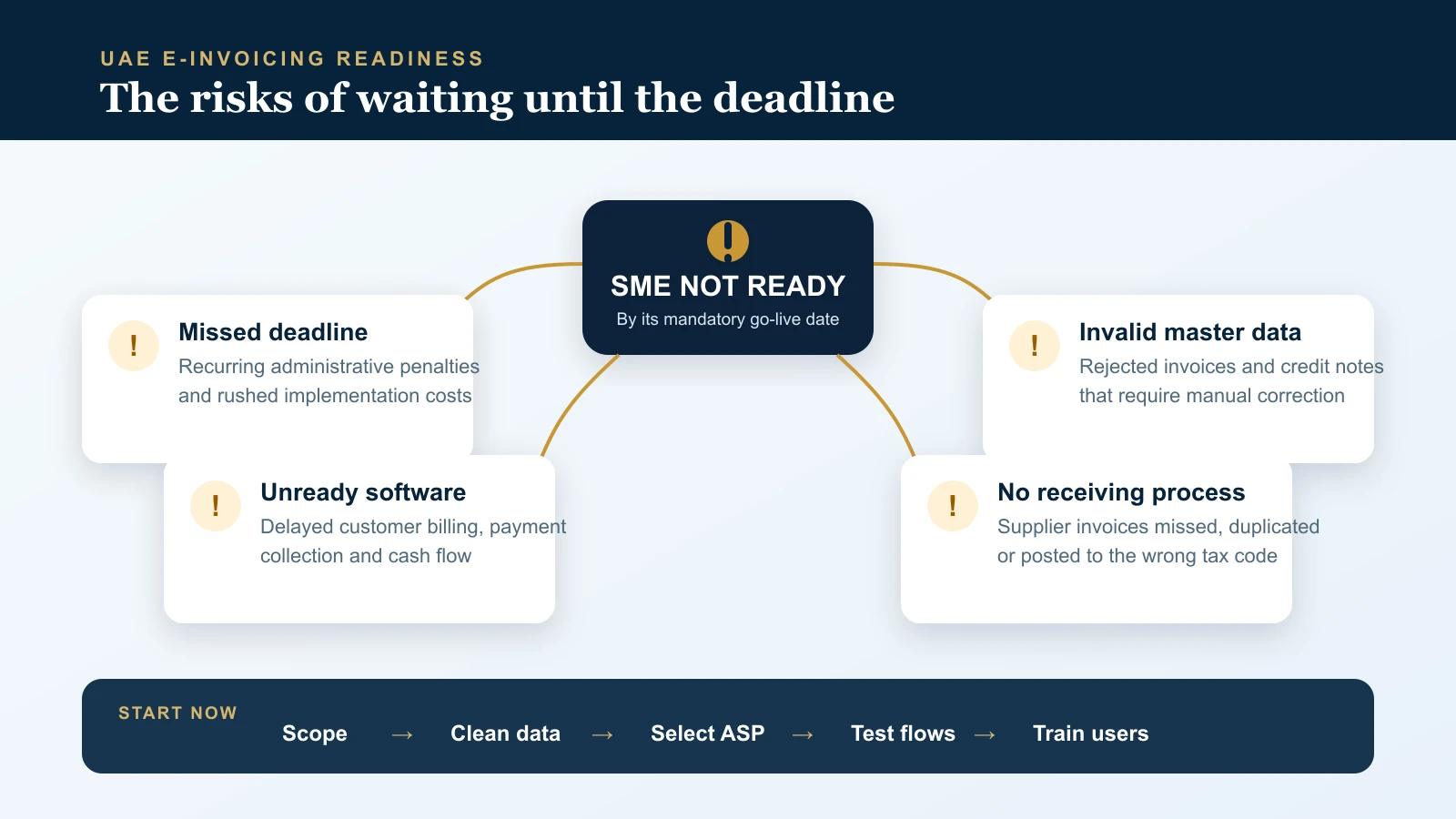
Provider selection is only one part of readiness. Data cleaning, software integration, user testing and exception handling often take longer than expected. Starting early reduces the risk of rejected invoices, delayed customer payments and rushed technology decisions.
Administrative penalties to plan for
| Potential failure | Published penalty |
|---|---|
| Failure to implement or maintain required e-invoicing compliance | AED 5,000 initially, then AED 5,000 for each month or part-month of continuing non-compliance, capped at AED 50,000 in any 12 consecutive months |
| Late issue or transmission of an e-invoice | AED 100 per invoice, subject to the applicable monthly cap |
| Late issue or transmission of an e-credit note | AED 100 per credit note, subject to the applicable monthly cap |
| Failure to notify the ASP of specified registered-data changes within the required period | AED 250 per day or part-day, subject to the applicable monthly cap |
Penalty rules can be amended. Always check the latest Cabinet Decision and official Ministry of Finance guidance before implementation.
Frequently asked questions
When does UAE e-invoicing become mandatory for SMEs?
For an in-scope person with annual revenue below AED 50 million, the current deadline to appoint an Accredited Service Provider is 31 March 2027 and the deadline to implement the system is 1 July 2027.
Does e-invoicing apply if my business is not VAT registered?
Yes, the framework applies to in-scope B2B and B2G transactions regardless of VAT-registration status. Your specific activities and exclusions still need to be reviewed.
Are Free Zone companies included?
Free Zone status does not automatically remove a business from the e-invoicing framework. Review the entity’s transactions and any specific exclusion that may apply.
Is an emailed PDF a valid UAE e-invoice?
No. A PDF, Word document, image, scan or email is not an e-invoice for this purpose. The invoice data must be structured, validated and exchanged electronically through the required system.
Do I need an Accredited Service Provider?
An in-scope business must appoint a Ministry of Finance Accredited Service Provider to send and receive e-invoices. Verify the provider against the current official MoF list before contracting.
Does a business that sells only to consumers need to prepare?
B2C sales are currently excluded, but a business that receives goods or services from other UAE businesses may still have an obligation as the recipient of B2B invoices. This is a common scope issue for retail and consumer-facing businesses.
Can I keep my current accounting software?
Possibly. The key question is whether the system can integrate reliably with an accredited provider and support both outgoing and incoming structured documents. Confirm the live UAE integration, cost and support arrangements in writing.
What data should SMEs clean first?
Start with legal customer and supplier names, TRNs or TINs, electronic addresses, trade-licence information, tax codes, payment terms and transaction classifications. Poor master data is a frequent cause of automated validation failures.
Need an SME e-invoicing readiness review?
VAT Centric can help you assess scope, review your accounting data, compare implementation routes and build a proportionate readiness plan for your UAE business.
Official UAE e-invoicing resources
- UAE Ministry of Finance eInvoicing portal
- Official list of Accredited Service Providers
- Federal Tax Authority UAE e-Invoicing guidance
Last reviewed: 22 November 2026. This guide provides general information and does not replace advice based on your business’s facts or the latest UAE legislation and official guidance.